Do I Need an ISBN for My Self-Published Book?
November 1, 2026 · 6 min read
If you're self-publishing, the ISBN question comes up early and the answers online often contradict each other. The short version: print books need one, ebooks often don't, and the choice you make affects who is listed as your publisher. Here's how it works.
What an ISBN is, and what it identifies
An ISBN (International Standard Book Number) is a unique identifier for a specific edition of a book. Bookstores, libraries, distributors and retailers use it to find and order the right product. A print book's barcode encodes its ISBN.
It identifies an edition, not a story. Your paperback and your hardcover are different products, so they are identified separately. The ISBN also points to registration details: the title, the author and the publisher name on record.
Which formats need one?
Each format of a book needs its own ISBN, and an ISBN isn't reused across formats or across new editions with significant changes. A paperback and a hardcover therefore need two. Whether an ebook needs one depends on where you sell it.
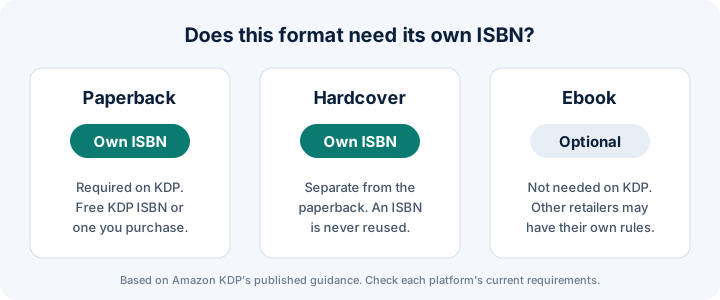
Amazon KDP says ebooks are one of the few formats where an ISBN is optional. Other retailers and aggregators set their own rules, so check each platform before you upload. Don't assume an ebook can't have an ISBN either; some authors assign one so every edition is tracked the same way.
How Amazon KDP handles ISBNs
For paperbacks and hardcovers, KDP gives you two choices:
- A free KDP ISBN. It works only on KDP, and your imprint appears as "Independently published."
- Your own ISBN, which you buy from an ISBN agency. You can use it elsewhere, and the imprint shown is the one you registered.
If you use your own ISBN, the title, author and imprint you enter in KDP must match what's registered with the agency exactly. Mismatches block publishing, and even a trailing space can cause one.
How IngramSpark handles ISBNs
IngramSpark is a distribution platform that reaches many bookstores and libraries. As we understand its current guidance, it expects you to supply your own ISBN for each title and doesn't assign one for you. Confirm this in your account before you upload, since platform rules change.
That matters if you start on KDP with a free ISBN and later want wider distribution. The free KDP ISBN can't be carried over, so you'd need a different ISBN for the same format.
Free ISBNs versus buying through Bowker
In the United States, Bowker is the official ISBN agency. A free platform ISBN costs nothing and is convenient, but it ties that edition to the platform and lists the platform's imprint. Buying your own gives you portability and lets you name the publisher. Bowker's fees depend on quantity and change over time, so check its current pricing instead of relying on a number from a blog post.
ISBN, publisher of record, copyright and distribution are different things
These four ideas get mixed up constantly:
- ISBN ownership: who registered the identifier with the agency.
- Publisher of record: the publisher name tied to that ISBN in bibliographic records and on the book's detail page.
- Copyright: your legal rights in the work. An ISBN doesn't create, prove or transfer copyright, and neither does an imprint name.
- Distribution rights: which platforms and retailers you may sell through, which depends on your agreements with them.
In other words, using someone else's ISBN or imprint doesn't change who wrote the book or who holds the copyright. It does change who is listed as the publisher, and sometimes where the edition can be sold.
Bookstores and libraries
Bookstores and libraries typically order through wholesalers, and they find titles using the ISBN and its metadata. A correct ISBN with accurate title, price and format data makes your book orderable. It doesn't guarantee a store will stock it or a library will buy it; that depends on the retailer and your distribution setup.
Common mistakes
- Using one ISBN for both the paperback and the hardcover.
- Reusing an ISBN after a significantly revised edition.
- Entering an imprint or author name that doesn't exactly match the registration.
- Taking a free ISBN, then discovering you can't use it on another platform.
- Buying a single ISBN when you'll need several formats.
- Assuming an ISBN protects your copyright.
When an imprint can help
Some authors want a publisher name on their book other than "Independently published," but don't want to form a company, buy ISBNs and register an imprint themselves. That's the gap a service imprint fills.
With the Guardian Press imprint, Guardian Press is the publisher of record for editions that use our ISBNs. You keep your copyright, creative control and royalties, and a written publishing agreement comes first. ISBNs aren't sold on their own and aren't transferable, so if you'd rather hold your own, buying through Bowker is a good choice. Either way, the right answer depends on where you want your book sold. If you'd like to talk it through, get in touch.